Agentforce Vibes: Can We Really Use AI to Write Code as Salesforce Admins?
February 11, 2026 · 6 min read
For as long as I can remember, our role as Salesforce Admins has been defined by the no-code/low-code philosophy. We’re the builders of our Salesforce orgs, the ones who leverage clicks-not-code tools like Process Builder, Workflow Rules, and, of course, Flows to automate business processes and customize user experiences. Our superpower? Understanding business needs and translating them into efficient, declarative solutions right within the Salesforce platform.
But what if the boundaries of no-code started to get a little blurry? What if we could not only understand complex Apex code but also generate it, debug it, and even deploy it, all without ever having to learn a coding language? This is exactly where Agentforce Vibes steps in, a game-changer for us, Salesforce Admins.
The big question I’ve been asking myself, and what we’re exploring today, is, can Agentforce truly empower us Admins to become viable coders, or at least highly proficient code-adjacent professionals? Let’s dive in and see what I’ve found.
The Shift from Traditional Admin to Admin+
The Salesforce ecosystem is always evolving, and with it, the demands on us admins. As our businesses grow more complex, so do our Salesforce implementations. While declarative tools are incredibly powerful, there are always those scenarios where Apex code just becomes necessary to achieve specific, nuanced requirements.
This is where I see the concept of Admin+ really taking shape. An Admin+ isn’t meant to replace a Developer; instead, we’re Admins augmented by AI. Agentforce Vibes fits perfectly into this vision, acting as a skill amplifier for us. It’s not about AI replacing our human expertise, but about enhancing it, allowing us to tackle challenges that were previously out of our reach, making us even more valuable to our organizations.
Setting Up Agentforce Vibes
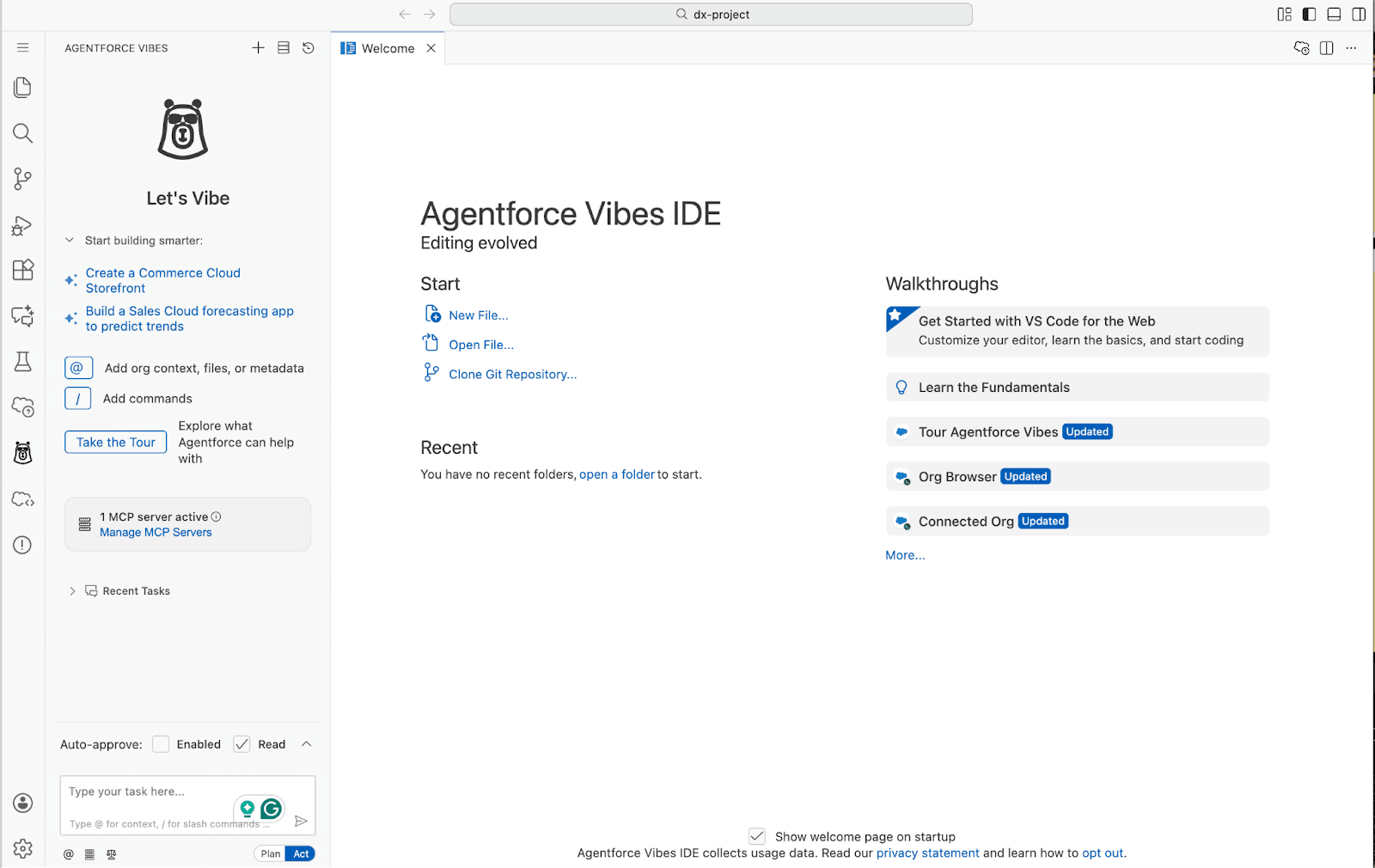
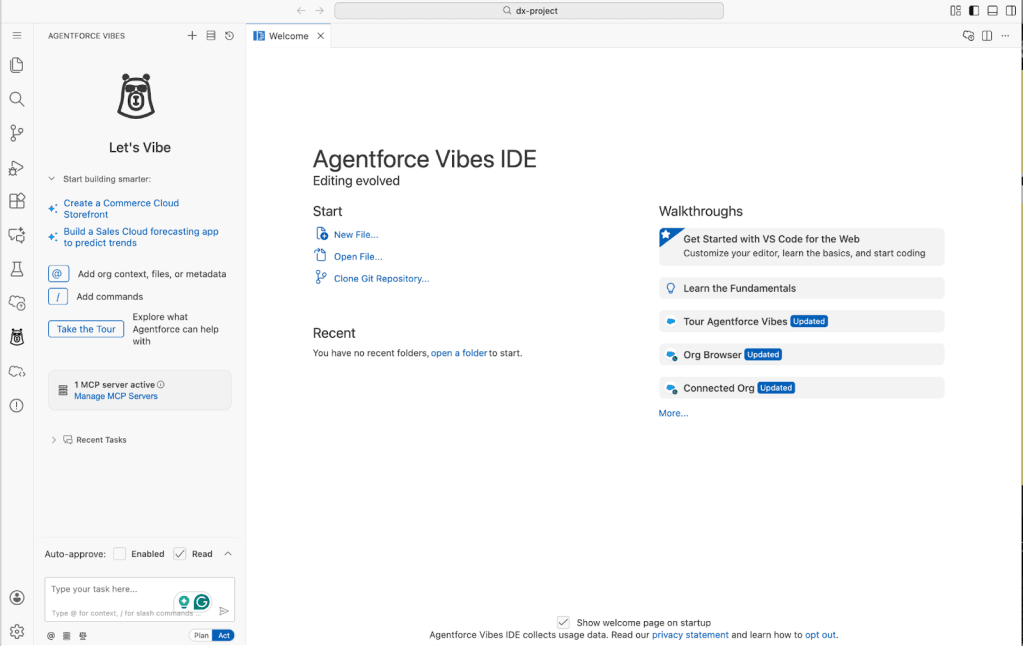
Getting started is actually pretty straightforward. Agentforce Vibes can be used either through a dedicated Integrated Development Environment (IDE) or as an environment in Salesforce itself. If you choose to go with Agentforce Vibes in the web browser, it will look like this, allowing you to vibe code right in your org (preferably a sandbox). Either way you set it up, you just have to click the AgentForce Vibes icon to get to vibe coding.
Explaining Code
One of Agentforce’s most valuable features, in my opinion, is its ability to break down complex Apex code into plain, understandable English. As a consultant, there are many hands constantly pushing code into my clients’ orgs. With Agentforce Vibes, I can simply specify the Apex Class or Trigger and ask it what it does, allowing me to get a much clearer picture of how everything works together. This is not only helpful for those who are not code inclined, but for the developers as well. Because instead of spending their time explaining what everything does, it speeds up knowledge transfer, allowing them to get back to coding and the Admins to understand everything quickly.
My Real-World Example: Bridging the Flow-Code Gap
Let’s walk through a recent project that perfectly illustrates Agentforce’s capabilities. I recently had a client request that seemed straightforward at first; they wanted a custom Lead creation process. I built a screen Flow to handle the user interface and initial logic, but I kept hitting a wall. The core issue was trying to bypass the default Lead conversion logic and existing validation rules that the Flow simply can’t do on its own. I thought I was staring down the barrel of a developer request, thinking that it was going to be a bigger project than it turned out to be.
Then, I remembered Agentforce Vibes. I opened VS Code, pulled my existing Flow into the environment, and then turned to Agentforce. I instructed it to create an Apex Class that could plug into the Flow and create records, using the Flow variables. Agentforce didn’t just generate code, it became my coding partner. It created two Apex Classes to handle the two possible outcomes and inserted them into the Flow by updating the XML file.
What truly impressed me was its iterative process. Agentforce ran test cases, identified issues, and then suggested and implemented resolutions. It was like having a developer by my side constantly testing, refining, and writing code. After several rounds of this guided iteration, I had a complete solution, a modified Flow with the new Apex Classes (including a test class) that Agentforce had written and refined. The best part, I was able to push all of it, the updated Flow and the three Apex Classes, directly from VS Code into the org with one command. This project, which would have previously required a developer and significant back-and-forth, was completed by me, an Admin, thanks to Agentforce.
Limitations and Considerations (Because It’s Not Perfect)
While Agentforce Vibes is incredibly powerful, we must approach it with a clear understanding of its role:
- We still need understanding: a foundational understanding of what the code should do and how Salesforce works. When prompting, I always made sure Agentforce understood the scope of its actions, explicitly telling it not to touch other code and asking it to explain its proposed changes before execution.
- It’s a tool, not a replacement for us: Agentforce is a sophisticated tool, not a substitute for our human intelligence. We must check its work. I treat its output as a highly intelligent first draft.
- Code review is essential: Before deploying any AI-generated code to a production environment, a thorough code review by a developer colleague is essential. This ensures quality, adherence to best practices, and prevents any issues in production.
Our Admin Work with Agentforce: The Future is Admin+
AI isn’t just transforming our Admin role; it’s elevating it. The Admin+ model, where we are Admins augmented by AI tools like Agentforce Vibes, is rapidly becoming the standard. Admins who embrace this technology aren’t just keeping up; we’re becoming more versatile, capable, and ultimately, more valuable members of our teams. We can contribute to projects that once required specialized developer resources, accelerating innovation and efficiency within our organizations.
Conclusion
Agentforce Vibes significantly expands our capabilities as Admins, allowing us to undertake more complex and higher-skilled work than ever before. With this Salesforce native agent, we can confidently write, interpret, and debug Apex code, bridging that gap between declarative and programmatic solutions.
The narrative isn’t about AI replacing us Admins, it’s about AI empowering us, making us more valuable, more capable, and more integral to the success of our Salesforce implementations. The future for Salesforce Admins is bright, and I truly believe it’s powered by intelligent tools like Agentforce Vibes.
Related Articles
10 Salesforce Permissions You Should Almost Never Assign to Users
If you have ever inherited a Salesforce org and opened up the…
June 30, 2026
17 Min Read
7 Popular Reporting Apps for Salesforce
The profit of your entire Salesforce investment depends a lot on the…
May 18, 2026
9 Min Read
How to Build a Salesforce Backup Strategy: What to Back Up, How Often, and Where to Store It
If you’ve ever read a blog post about Salesforce backup that left…
April 30, 2026
16 Min Read

Partners

Company
Get in touch
Locations: New Hampshire, India, Maine, Colorado, Poland, Ukraine, Belarus
Email: help@cloudanswers.com
Phone: +1 508 500 8333