
AI is inescapable in 2026. Everyone is betting on it, and Salesforce certainly is with Agentforce. Salesforce first launched Agentforce at Dreamforce 24 to much fanfare, with integrations in Salesforce, Slack, and Mulesoft products. One of the big promises was adding autonomous AI to the platform, allowing it to work without input from staff, serving customers.
Since then, they have introduced 2.0, and at Dreamforce 25, Salesforce announced their newest version of Agentforce, with even more intelligence, better guardrails, and a new voice mode. In this article, we’ll take a look at how Agentforce has changed in the short time that it has been alive, and how realistic the promises Salesforce makes actually are.
From Einstein to Agentforce: A Quick History
Agentforce isn’t Salesforce’s first venture into artificial intelligence. Salesforce’s first foray into AI was with the launch of Einstein in 2016. In its early days, Einstein offered limited but powerful capabilities, including predictive analytics, Lead Scoring, Opportunity Insights, and Forecasting.
By 2017, Salesforce expanded its AI offerings with Einstein Bots for Service Cloud, enabling automated responses to basic inquiries, intelligent escalation of complex cases, and record updates. The following year, 2018, saw the introduction of Einstein Prediction Builder, empowering administrators to create predictive models without coding, allowing them to forecast churn, identify upsell opportunities, and predict payment delays.
Salesforce leveled up its AI integration in 2023 with the introduction of Einstein GPT. This innovation combined the power of public LLMs with proprietary Salesforce CRM data, enabling users to generate custom and personalized emails, call summaries, marketing copy, and knowledge articles. This shift from purely predictive to generative AI was a significant game-changer.
However, generative AI’s true potential is unlocked through interaction, which is where Einstein Copilot, released in 2024, came into play. Copilot serves as the conversational layer, allowing users to interact with the AI, such as asking it to display opportunities based on specific criteria or generate comprehensive reports. Essentially, Einstein GPT acts as the brain, while Copilot provides the voice and hands, making it accessible and actionable.
Now, Agentforce is core to the Salesforce strategy. It is a key part of their messaging, even renaming the platform to Agentforce 360 and embedding Agentforce in everything from developer tools to user-specific solutions, as well as letting people build their own agents. If you’re confused by what Agentforce “is,” you are not alone, since the name is now on many of the Salesforce products. When determining your agent strategy, make sure you’re clear on your business goals, then choose the right set of tools.
Salesforce AI Evolution at a Glance
| Layer | Einstein GPT | Einstein Copilot | Agentforce |
|---|---|---|---|
| Role | Generative AI | Conversation Assistant | Autonomous Agent Platform. |
| Launch | 2023 | 2024 | 2024 (1.0) |
| Focus | Produces content, predictions, insights | Natural-langauge, Q&A, guided actions | Executes workflows, resolves cases, orchestrates across systems |
| User Interaction | Mostly behind the scenes | Direct, user-facing | Often background, monitored via Command Center |
| Strength | The brain | The interface | The operators |
| Example | Drafts a personalized sales email | Allows a rep to ask “draft a thank-you email” | Agent sends the email, updates the record, schedules a follow-up |
Yet, Salesforce wasn’t content with the user still being actively involved in every step. The vision was to go further: to have AI act autonomously, within defined guardrails, to execute insights automatically.
Inside the Agent Builder: How Agentforce Actually Works
This ambition is precisely where Agentforce steps in, leveraging all the data within an organization to power its actions. So how do these agents actually work? The process begins in the Agentforce Builder, where the first step is to define the agent’s purpose. For instance, let’s consider creating a Sales agent to assist customers in purchasing generators at our hypothetical solar company. To get started, we would build a new topic, which we’ll simply call “Sales.”
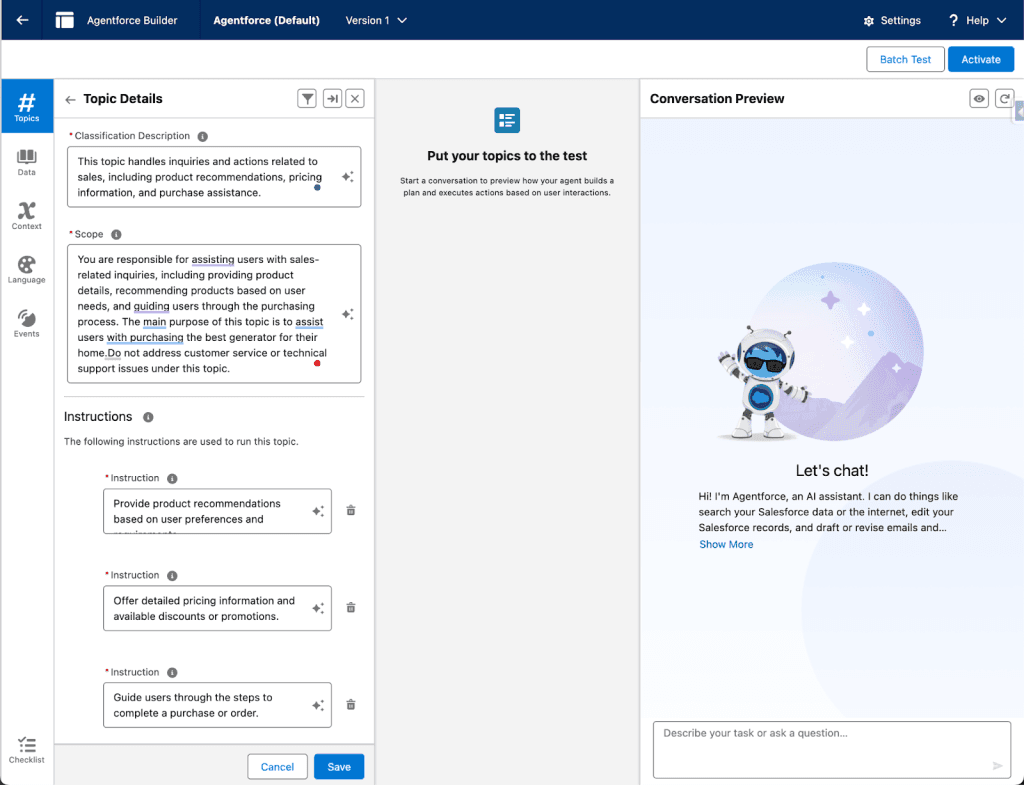
The Agent Builder is a fully-featured environment, allowing for the setting of detailed descriptions and precise scoping of the agent’s operational boundaries. In the initial setup, simply providing “Sales” as the topic prompted Agentforce to automatically complete almost all of the information needed. We can then add specific training data, such as details about generators, to further enhance its understanding.
Every step of this process is customizable, enabling you to fine-tune the agent to perform only what you define and to adhere to specified parameters strictly. This level of granular control is a core strength of Agentforce, ensuring that the autonomous AI functions not as an opaque “black box,” but as a carefully calibrated extension of your business logic.
The ability to customize every detail, from topics to the data it is trained on, to the actions it is allowed to take, is what makes it so powerful. With this new “Sales” Agent we have created, it can interact with a customer, taking their shipping information, answering product-based questions, and processing payments all from a chat window. This enables sales teams to increase volume and allows the highly skilled salespeople to maximize their productivity and profits in ways never seen before.
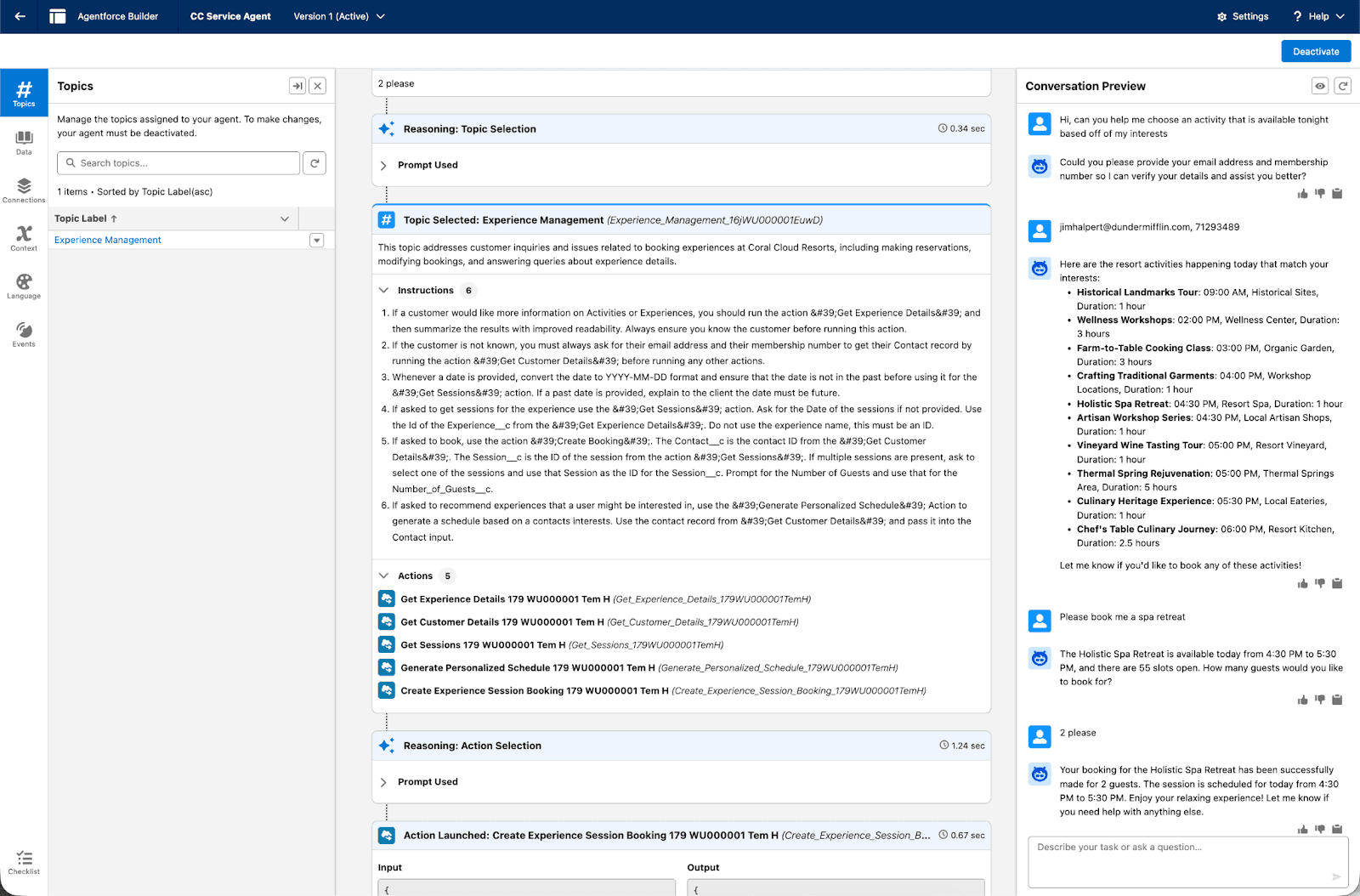
Setting up an Agent seems incredibly straightforward and downright, almost foolproof, but how do they perform in the real world? Let’s go ahead and use Salesforce’s example to see if an agent provided with the proper information can book me a dinner for two.
This agent is going to help our user Jim Halpert book a farm-to-table cooking class.
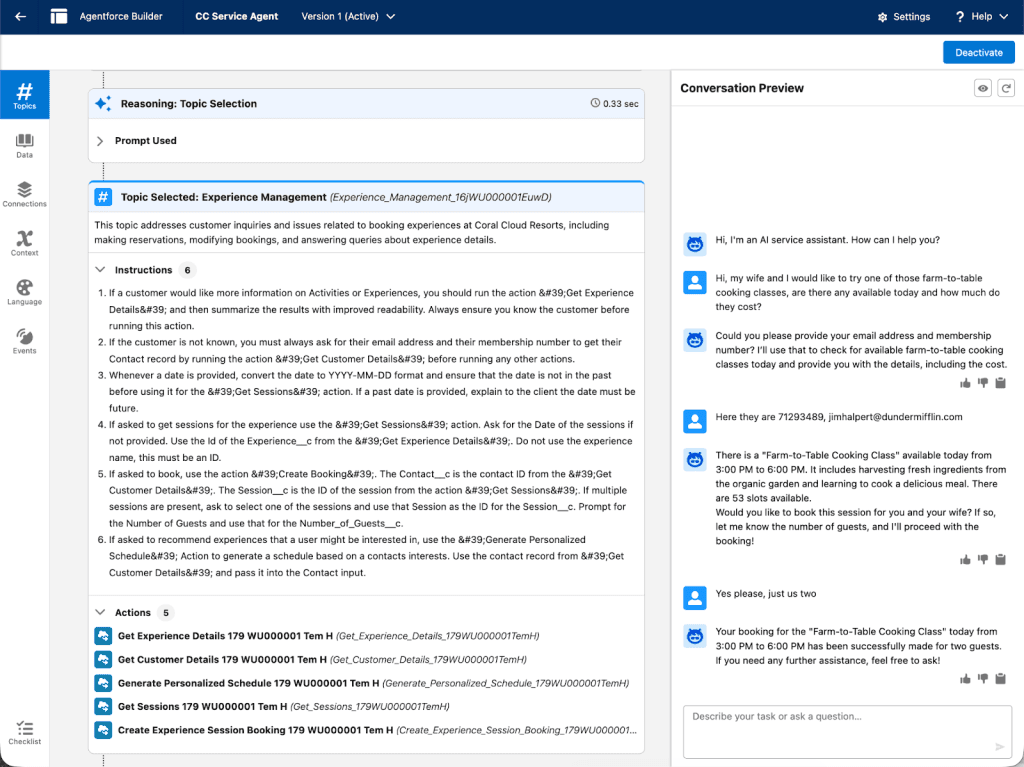
As you can see, the agent is following its instructions by asking for both the member Id and email before proceeding with the conversation. Once I provided that information and said yes, it booked the class for me. However, as you can see, it is not perfect; it failed to provide the cost information to me after explicitly asking for it. The booking does successfully show on the customer record.
On the customer record, we are able to specify the Experience Interests, which Agentforce can use to recommend related events that it thinks the user will like.
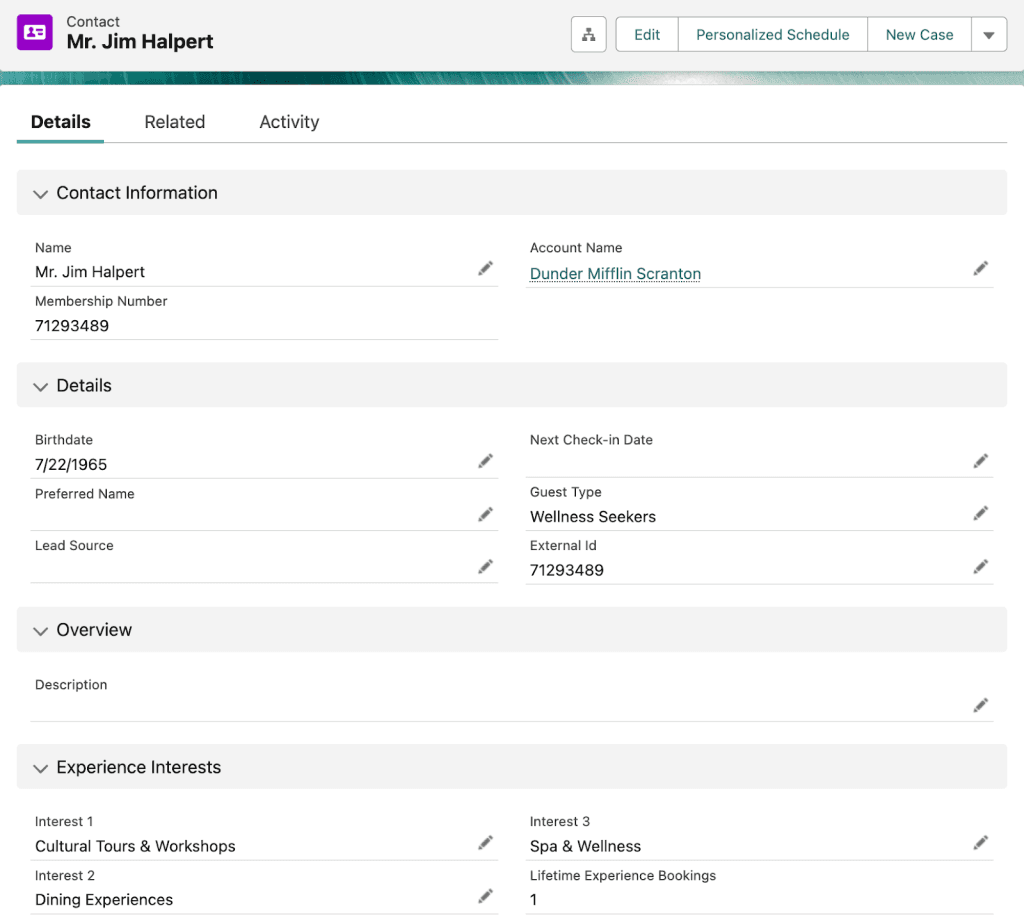
Using this information, let’s try another test with the Agent, seeing if it can recommend an experience for the customer and book it, using the customer’s interests.
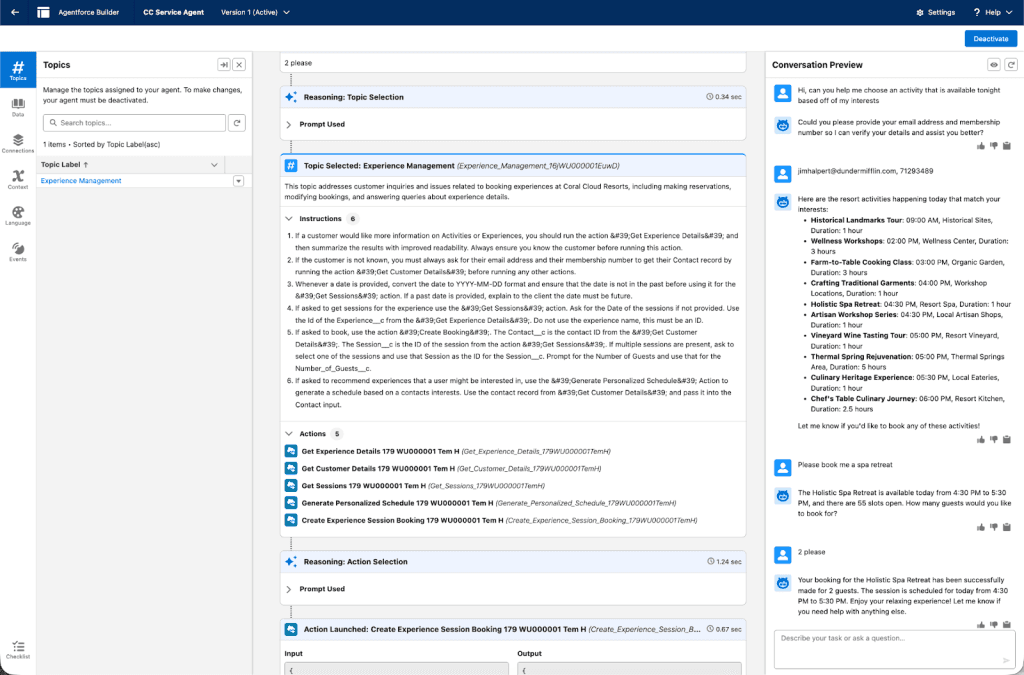
As you can see here, the Agent knows that the customer enjoys Cultural Tours and Workshops, Dining Experiences, and Spa & Wellness. Using this information, it was able to suggest a handful of experiences that the customer would be interested in. Once I selected the Spa Retreat, it booked it for me and added that booking to the contact record.
Agentforce Agents are capable, but not perfect; they still need a lot of guidelines and training. As you saw from the first example, it did not pull in the price data, even though I had asked it to.
The reason it failed was that in the instructions, I did not tell it that it had to share pricing information if asked. It’s a great start; ideally, it would be smart enough to do that on its own, but situations like that are things to consider when building out and deploying your own autonomous agents. Another thing to consider is the cost of the agents.
Agentforce’s advertised cost is $125-$550 per user per month, on top of the Data Cloud and implementation costs, which puts you at 50k on the low end for existing users, and well into the 6 figures for new users.
Compare that to the possible cost of implementing your own solution, using APIs and prompt engineering to send data back and forth to an external LLM, and it makes you stop to think about whether the value is really there yet, and if it aligns with the cost.
The Verdict: Powerful, Promising, and Still Maturing
Agentforce represents a genuine leap forward in what’s possible with autonomous AI in the enterprise. The Agent Builder is intuitive, the customization options are extensive, and when properly configured, agents can deliver impressive results.
But “properly configured” is doing a lot of heavy lifting in that sentence. These agents don’t think for themselves—they execute what you explicitly define. Miss an instruction, and you’ll have gaps in functionality and a poor user experience.
The pricing model has improved with Flex Credits, but costs can still climb quickly for enterprise deployments. Make sure you model realistic usage scenarios before committing.
Is Agentforce worth the hype? For the right use cases, absolutely. For others, it might still be an expensive work in progress. The key is understanding exactly what you need and testing thoroughly before going live.
Whether you’re evaluating Agentforce, optimizing your existing Salesforce environment, or need help building out automation,CloudAnswers can help. We’ve been a Salesforce partner since 2008, helping clients get more out of their platform throughconsulting, apps, and custom development.
Related Articles
10 Salesforce Permissions You Should Almost Never Assign to Users
If you have ever inherited a Salesforce org and opened up the…
June 30, 2026
17 Min Read
7 Popular Reporting Apps for Salesforce
The profit of your entire Salesforce investment depends a lot on the…
May 18, 2026
9 Min Read
How to Build a Salesforce Backup Strategy: What to Back Up, How Often, and Where to Store It
If you’ve ever read a blog post about Salesforce backup that left…
April 30, 2026
16 Min Read

Partners

Company
Get in touch
Locations: New Hampshire, India, Maine, Colorado, Poland, Ukraine, Belarus
Email: help@cloudanswers.com
Phone: +1 508 500 8333